

Lauryn
Founder, PRIMALS
Your Toothbrush Is Destroying Your Gums. Dentists Call It Toothbrush Disease.
You see it every time you look in the mirror. That little bit of yellow near the gum line that was not there before. Your teeth feel more sensitive to cold water. Your dentist mentions "recession" during your check-up, and you nod along, but a knot of anxiety tightens in your stomach. You are doing everything right. Brushing twice a day, flossing, avoiding candy. So why do your gums look like they are disappearing?
What if the very tool you trust to protect your teeth is the secret culprit behind their destruction? Dentists have a name for it: toothbrush disease. It is not a bacterial infection. It is physical trauma, the result of literally scrubbing your delicate gum tissue into oblivion with nylon bristles. An estimated 24 million people suffer from this condition every year (Journal of Periodontology).
The Research Says
People who use hard-bristled toothbrushes have twice as much gum recession (9.4% of surfaces) compared to those who never used them (4.7%). Gum recession is not reversible. Once that tissue is gone, it does not grow back on its own. Severe cases require gum graft surgery that can cost thousands of dollars per tooth.
Source: Khocht et al., Journal of Periodontology, 1993
The Nylon Nightmare: How Toothbrush Disease Destroys Your Gums
For decades, we have been told to brush vigorously to remove plaque. But this advice was built around a fundamental misunderstanding. Plaque, the bacterial film we are trying to remove, is as soft as yogurt. It does not require aggressive force. Yet, we have been handed abrasive nylon bristles and told to scrub away.
Your gums are not built for this kind of abuse. They are paper-thin, and tooth enamel is only about as thick as an eggshell. The stiff, often poorly-rounded nylon bristles on a standard toothbrush act like a wire brush on this delicate ecosystem. Day after day, this micro-abrasion wears away your gums, causing them to recede and exposing the sensitive root surface underneath.

24M
people suffer from toothbrush disease every year
47%
of US adults aged 30+ already have some form of gum disease (CDC)
2x
more gum recession in hard-bristle users vs. those who never used them
What makes this even more alarming is the scale of the problem. According to the CDC, 47.2% of all adults aged 30 and older already have some form of gum disease. That is roughly 64 million Americans. And the rate climbs with age: nearly 60% of adults 65 and older are affected. The daily abrasion from nylon bristles is pouring gasoline on a fire that is already burning.
This daily trauma is the root cause of toothbrush disease. While you think you are cleaning your teeth, you are actually creating a pathway for bigger problems, including sensitivity, root cavities, and eventually, tooth loss. In fact, gum disease is the leading cause of tooth loss in adults worldwide.
Why Toothbrush Disease and Gum Recession Go Far Beyond Your Gums
The damage caused by nylon bristles does not stop at gum recession. It sets off a chain reaction that makes everything worse, starting with the toothpaste you are probably using right now.
You notice your teeth looking a bit yellow from the recession, so you reach for a whitening toothpaste. It seems like a logical solution, but you have just walked into a trap. Most whitening toothpastes work by being highly abrasive. They are essentially sandpaper in a tube. These products are rated on a scale called Relative Dentin Abrasivity (RDA). While the FDA sets a safety limit of 200, many popular whitening and charcoal toothpastes push this limit, aggressively scraping away not just stains, but your precious enamel (Applied Sciences, 2020).
⚠ What Most People Miss
As abrasive whitening toothpaste wears down your white enamel, it exposes the naturally yellowish layer of dentin underneath. Your attempt to whiten your teeth is actually making them permanently more yellow. You are accelerating the very problem you are trying to solve, all while your gums are still under daily assault from your nylon toothbrush.

And there is another dimension most people never think about. Every time you brush with a nylon toothbrush, tiny fragments of plastic break off from the bristles and enter your mouth. You swallow them. You absorb them through your gum tissue. A 2023 study found that a single plastic toothbrush releases 88,000 microplastic particles per year that you ingest (PMID: 38092338). A newer 2025 study revised that number dramatically upward, finding that plastic toothbrushes can release up to 2.3 million microplastic particles per year (Ecotoxicology and Environmental Safety, 2025).
These are not just inert particles. Research has shown that microplastics have bioadhesive properties, meaning they stick to your gum tissue, tongue, and oral mucosa. They carry with them the chemicals embedded in the plastic: BPA, phthalates, and PFAS, all of which are known endocrine disruptors linked to hormonal imbalance, fertility issues, and cancer risk.
So your nylon toothbrush is doing double damage. It is physically scraping your gums away while simultaneously flooding your body with toxic microplastic particles. Twice a day. Every single day.
The Solution to Toothbrush Disease: Change the Tool, Not the Technique
You cannot solve a problem caused by abrasion with more chemicals or different techniques. The issue is not how you brush. The issue is what you are brushing with. You have to change the tool itself.
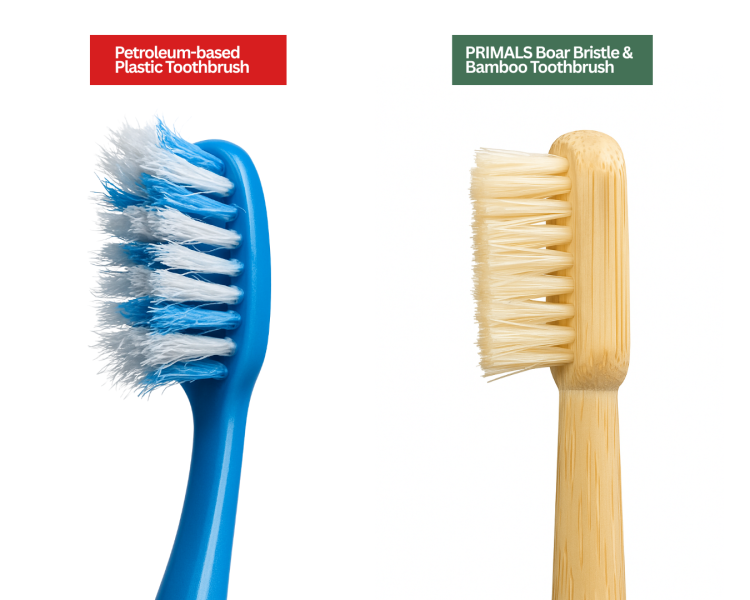
The core problem with nylon bristles is that they are made from petroleum-based plastic that is too rigid for the delicate tissue in your mouth. No matter how gently you try to brush, the stiff tips of nylon bristles create micro-abrasions on your gum line with every stroke. Over months and years, those tiny scratches accumulate into visible recession.
The solution is a bristle material that is soft enough to clean the gum line without causing abrasion, while still being effective at removing the soft plaque film from teeth. Natural animal hair bristles have been used for oral care for centuries before nylon was invented in the 1930s. They are inherently softer than synthetic alternatives because they are protein-based fibers rather than petroleum-based plastics.
Don't Be Fooled
The majority of "eco-friendly" bamboo toothbrushes on the market still use nylon bristles. The handle may be sustainable, but if the bristles are still made from petroleum-derived plastic, you are still getting the same gum abrasion and microplastic exposure that causes toothbrush disease. The bristle material is what matters most for your gums.
The most important thing to understand is that plaque is soft. It does not require an abrasive tool to remove. A softer bristle that can flex around the gum line actually cleans more effectively than a stiff bristle that scrapes across the surface and misses the areas where plaque actually accumulates. The goal is gentle effectiveness, not brute force.
How the PRIMALS Toothbrush Stops Toothbrush Disease at the Source

The PRIMALS Horse Bristle and Bamboo Toothbrush is designed based on the principle of gentle effectiveness. Unlike stiff, petroleum-derived nylon, our bristles are made from 100% natural horse hair, which is renowned for its softness and durability.
Our horse hair bristles are so fine and flexible, almost like silk, that they can clean the delicate area around the gum line without causing abrasion or irritation. This is not a compromise on cleaning power; it is a smarter way to clean. The bristles flex into the spaces between teeth and along the gum line where stiff nylon bristles simply scrape across the surface.
🐴
100% Natural Horse Hair Bristles
Ultra-soft, silk-like natural protein fibers. No nylon, no plastic, no petroleum.
🌿
Sustainable Bamboo Handle
Single piece of bamboo. Free-standing quick-dry design prevents mold.
🛡️
Gum-Safe by Design
Flexes around the gum line instead of scraping it. Prevents toothbrush disease.
🔐
Zero Microplastic Shedding
No BPA, phthalates, or PFAS. Natural fibers break down safely, not into toxic fragments.
Want a firmer option for a deep clean? The PRIMALS Boar Bristle Toothbrush offers a naturally firm brushing experience that removes plaque and buildup without shedding microplastics. Both options give you a completely plastic-free, toxin-free clean.
By switching to the PRIMALS Horse Bristle Toothbrush, you are fundamentally changing your oral care routine from an abrasive, damaging process to a gentle, healing one. You are giving your gums the chance to recover and stop the cycle of recession at its source.

Stop brushing your gums away.
Join thousands who made the switch to gum-safe oral care.
SHOP THE HORSE BRISTLE TOOTHBRUSH NOWI will never forget the panic I felt at my last dental cleaning before I started PRIMALS. My dentist pointed at my X-ray and said I had early-stage recession on three teeth. I was 28 years old. I brushed twice a day, every single day. I thought I was doing everything right.
That night I started researching what was actually causing gum recession, and every study I found pointed back to the same thing: nylon bristle abrasion. The tool I trusted to protect my teeth was the tool destroying my gums. That realization changed everything. I knew PRIMALS had to offer a toothbrush that actually protected people instead of quietly damaging them.
— Lauryn, Founder of PRIMALS
Frequently Asked Questions About Toothbrush Disease
Your Gums Do Not Grow Back. Protect Them Now.
Gum recession is not reversible. Once that tissue is gone, it is gone for good, often requiring expensive and painful gum graft surgery to repair. The most powerful step you can take is to stop the damage from happening in the first place.
The fix is simple. Stop using a tool that is actively harming you. Your teeth and gums deserve better than a daily scrubbing with plastic.
Your Gums. Your Health. Your Choice.
Make the switch today. Your gums will thank you tomorrow.
SHOP THE HORSE BRISTLE 4-PACK NOWKeep Reading